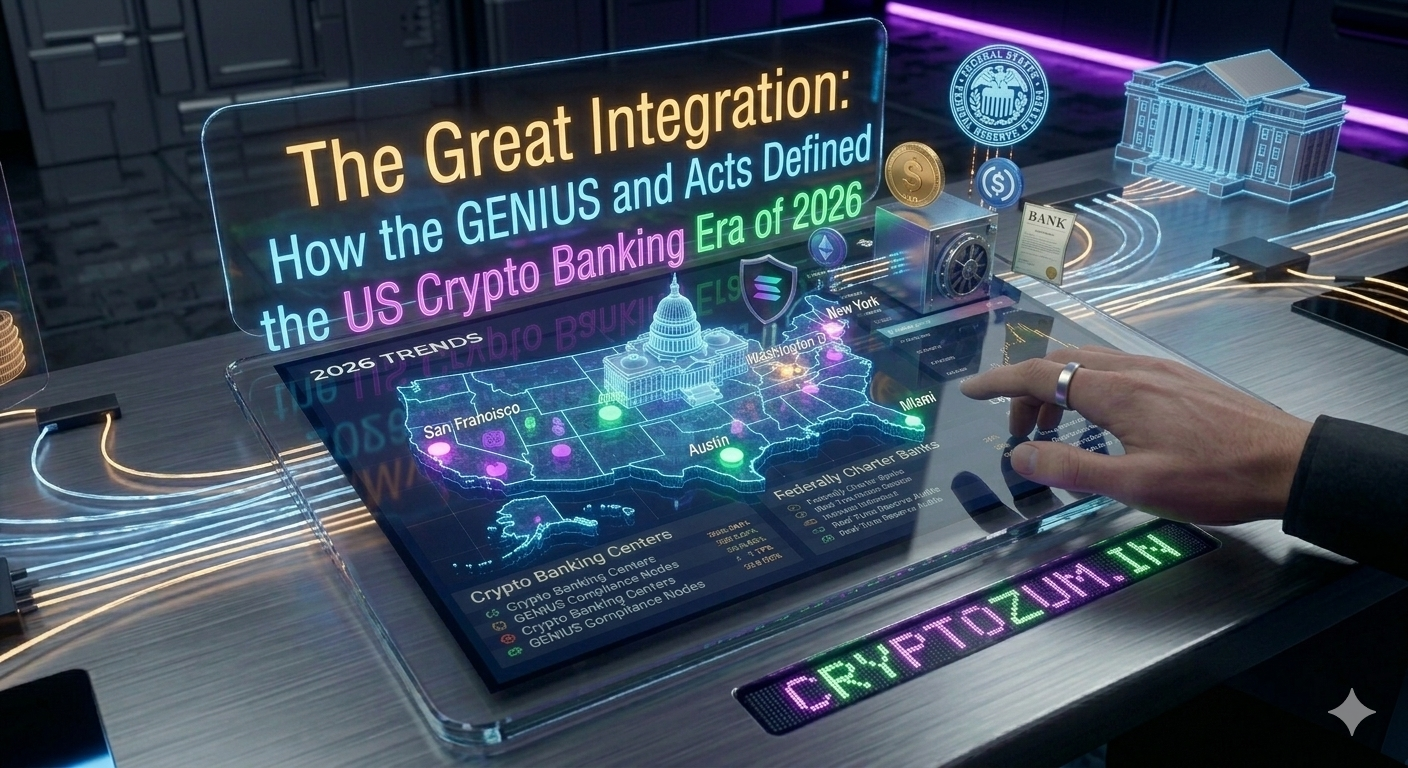
For over a decade, the relationship between the US government and the cryptocurrency industry was defined by “regulation by enforcement.” However, as we cross into March 2026, the narrative has flipped. With the passage of the GENIUS Act and the CLARITY Act, the United States has officially integrated digital assets into the federal banking system, marking the end of the “Wild West” and the beginning of the “Institutional Era.”
1. The Federal Crypto Banking License: A New Standard
In a historic move this March, eleven major companies—including Circle, Ripple, Fidelity, and Morgan Stanley—filed for or received OCC National Trust Bank Charters.
- What it means: These are not just “crypto exchanges” anymore. They are federally recognized banks that can custody digital assets across all 50 states under a single regulatory framework.
- Kraken’s Milestone: On March 4, 2026, Kraken Financial became the first digital asset bank in US history to receive a Federal Reserve Master Account, granting them direct access to the Fed’s payment rails.
2. Breaking Down the GENIUS Act vs. The CLARITY Act
US investors often get confused by these two bills. Here is the definitive breakdown:
The Legislative Comparison Chart (2026)
| Feature | GENIUS Act (Stablecoins) | CLARITY Act (Market Structure) |
| Primary Goal | Federal standards for Stablecoins. | Defines “Commodity” vs. “Security.” |
| Issuer Rules | Only banks or “Qualified Non-Banks” can issue. | Exchanges must register with SEC/CFTC. |
| Consumer Benefit | 1:1 Reserve auditing (No more “Luna” events). | Clearer tax reporting and anti-fraud rules. |
| Key Player | $USDC$ and $PYUSD$ (PayPal). | $BTC$, $ETH$, and $SOL$. |
3. The SEC “Token Taxonomy”: Who is a Security?
On March 3, 2026, the SEC submitted its long-awaited Commission Interpretation on Crypto Assets. This guidance finally established a “Token Taxonomy.”
- Digital Commodities: Decentralized tokens like $BTC$ and $ETH$ now officially fall under the CFTC (Commodity Futures Trading Commission).
- Restricted Digital Assets: Tokens that are centralized or have “unilateral authority” remain under the SEC jurisdiction.
- The Impact: This clarity has allowed US-based companies to launch thousands of new products without the fear of lawsuits.
4. The Rise of “DePIN” (Decentralized Physical Infrastructure)
While banking is being regulated, the technology is moving into the real world. In 2026, the DePIN sector has reached a $20 Billion market cap.
- Helium ($HNT$): Over 800,000 hotspots in the US are now providing decentralized 5G.
- Hivemapper ($HONEY$): US drivers are earning tokens for mapping roads, creating a decentralized competitor to Google Maps.
- Render ($RENDER$): US-based AI startups are now renting GPU power from a decentralized network of gamers rather than relying solely on Amazon (AWS).
5. The “Bitcoin Reserve” and Macro Policy
Perhaps the biggest shock of 2026 is the creation of the US National Digital Asset Stockpile. Reports suggest the US government now holds over $29 Billion in Bitcoin.
- Strategic Asset: Bitcoin is now viewed by the White House as a “strategic reserve” to hedge against US Dollar depreciation.
- The Warsh Era: With Kevin Warsh nominated as the next Fed Chair, the market expects a “Pro-Bitcoin” monetary policy that favors digital asset growth.
6. Security and “Proof of Personhood”
As AI deepfakes become a threat to US banking, the industry is shifting toward Zero-Knowledge Identity (ZK-ID).
- US citizens can now complete “KYC” (Know Your Customer) once and use a “ZK-Proof” to access any DeFi platform without repeatedly sharing their Social Security Numbers.
Conclusion: The Final Frontier of Finance
The events of March 2026 have proven that crypto is no longer a “competitor” to the US Dollar; it is the infrastructure that the new US Dollar will run on. For developers, investors, and everyday users, the message is clear: The system has been built. The rules are set. It’s time to scale.