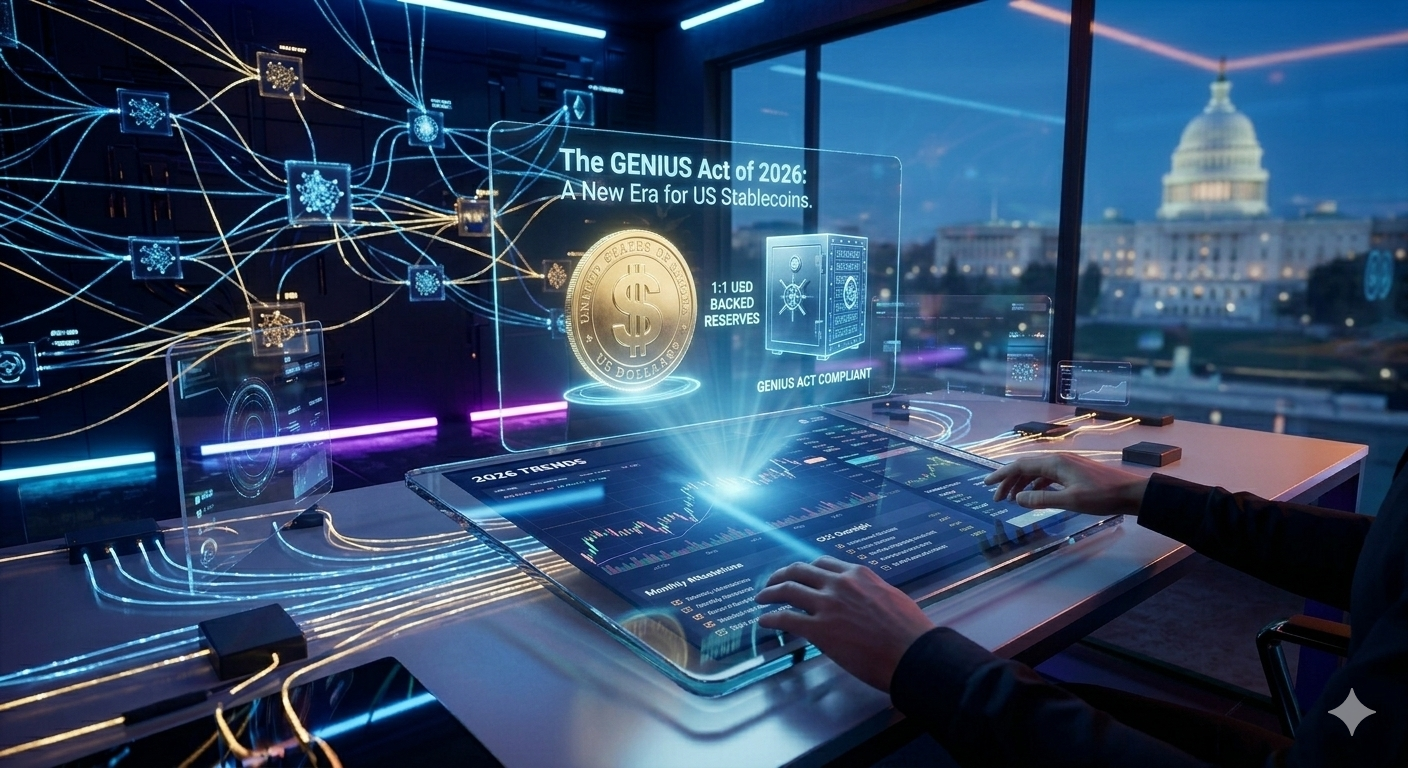
The landscape of digital finance in the United States has undergone a seismic shift with the official implementation of the Guiding and Establishing National Innovation for U.S. Stablecoins (GENIUS) Act. For years, the stablecoin market operated in a legal gray area, but as of March 2026, the Office of the Comptroller of the Currency (OCC) has established a federal framework that brings digital dollars into the heart of the American banking system.
1. The Federal Mandate for 1:1 Reserves
The cornerstone of the GENIUS Act is the strict 1:1 backing requirement. Every “Permitted Payment Stablecoin Issuer” (PPSI) must now maintain reserves in highly liquid, US-dollar-denominated assets.
- Eligible Assets: Only US coins/currency, Federal Reserve deposits, and short-term Treasury bills (maturing in 90 days or less) are permitted.
- Monthly Certifications: Issuers are now required to publish monthly attestation reports certified by top-tier US accounting firms and their own CEOs.
2. The Prohibition of Interest and Yield
In a controversial move, the GENIUS Act strictly prohibits stablecoin issuers from paying interest or yield directly to holders. This is designed to separate “payment instruments” from “investment securities.”
- Impact on Retail: While you won’t earn interest just by holding $USDC$, this move has increased trust among institutional investors who view stablecoins as a safe “cash equivalent” for corporate treasuries.
[Image 1: A high-tech digital vault with a holographic US Dollar and a blockchain ledger glowing in blue and gold]
Article 2: Ethereum’s Pectra Upgrade: Transforming the L2 Economy
In March 2026, the Ethereum network successfully deployed the Pectra Upgrade (a fusion of Prague and Electra). This is not just a minor patch; it is the most significant technical evolution since “The Merge,” directly addressing the scalability needs of the US-led decentralized finance (DeFi) sector.
1. The 95% Fee Slash for Layer-2s
Through the implementation of EIP-7742 (Dynamic Blob Adjustment), the Pectra upgrade has optimized how data is stored on-chain.
- The Result: Transaction fees on US-favored L2s like Base (Coinbase) and Optimism have dropped by an average of 95%.
- Micro-Transactions: For the first time, $0.01 payments are economically viable on Ethereum-based networks, opening the door for mass-market retail apps.
2. Introduction of “Smart Accounts” (EIP-7702)
One of the biggest hurdles for US adoption was “Seed Phrase” management. Pectra introduces native Account Abstraction, allowing regular wallets to act like smart contracts.
- Social Recovery: Users can now recover lost accounts using email or biometrics.
- Batch Transactions: You can now approve and swap a token in a single click, significantly improving the UX for American mobile users.
[Image 2: A futuristic visualization of Ethereum’s neural network nodes connecting to a high-speed fiber optic bridge]
Article 3: DePIN: The $3.5 Trillion Infrastructure Revolution in the USA
As we move through 2026, Decentralized Physical Infrastructure Networks (DePIN) have transitioned from a crypto narrative into a measurable component of the US economy. With over 41.8 million devices connected worldwide, DePIN is disrupting traditional telecommunications and energy sectors.
1. Decentralized Wireless (DeWi) Scaling
Projects like Uplink and Helium are providing a real alternative to traditional carriers. In rural America, where 5G rollout has been slow, community-owned DePIN nodes are filling the gaps.
- OpenRoaming Integration: Standardized roaming protocols now allow US users to switch between private WiFi and DePIN networks seamlessly without losing connectivity.
2. The Decentralized Energy Grid
Daylight and similar protocols are coordinating home energy devices (solar panels, EV chargers) across states like California and Texas.
- Grid Balancing: By using blockchain incentives, these networks help US utilities balance the grid during peak hours, earning homeowners “Green Energy Rewards” in real-time.
[Image 3: A glowing 3D map of the USA with interconnected network nodes and green energy icons over major cities]
Article 4: AI-Crypto Convergence: The Rise of Autonomous Trading Agents
In 2026, the most explosive narrative is the intersection of Artificial Intelligence and Blockchain. We are no longer just using AI to read charts; we are deploying Autonomous Economic Agents that live on the blockchain.
1. Decentralized Compute Marketplaces
With the global shortage of high-end GPUs, projects like Render ($RENDER$) and Akash ($AKT$) have become the “Airbnb of Compute” for US startups.
- Incentivized Intelligence: Bittensor ($TAO$) has scaled its subnets, creating a decentralized marketplace where AI models compete to provide the most accurate outputs, rewarded by the protocol’s native token.
2. Intent-Based Trading
US retail investors are shifting to “Intent-Based” platforms. Instead of setting manual limit orders, users tell an AI agent their goal (e.g., “Hedge my portfolio against inflation using RWA tokens”). The AI then finds the best liquidity across all DEXs to fulfill the request instantly.
[Image 4: A cinematic 3D render of a futuristic AI avatar manipulating a holographic display of market data and crypto tokens]
Article 5: Bitcoin as a Macro Staple: The Q1 2026 Market Analysis
Despite the “Extreme Fear” experienced in late February, Bitcoin ($BTC$) has entered March 2026 as a matured, institutional asset. With Bitcoin ETFs now holding over $250 Billion in AUM, its price action is increasingly tied to US macro liquidity.
1. The Institutional “Reversal”
On-chain data for March 7 shows that while retail sentiment is cautious, Whale Wallets have accumulated over 13,000 BTC in the last two weeks.
- The “Warsh” Factor: The nomination of pro-crypto figures to the Federal Reserve has signaled to Wall Street that Bitcoin is now a permanent fixture of the US strategic financial reserve.
2. Real-World Asset (RWA) Tokenization
The “Tokenization of Everything” has reached a turning point. US Treasury bills, private equity, and real estate are now being traded as on-chain tokens on networks like Avalanche and Ethereum.
- Liquidity: For the first time, US investors can gain exposure to fractionalized New York real estate with as little as $100, settled instantly in stablecoins.