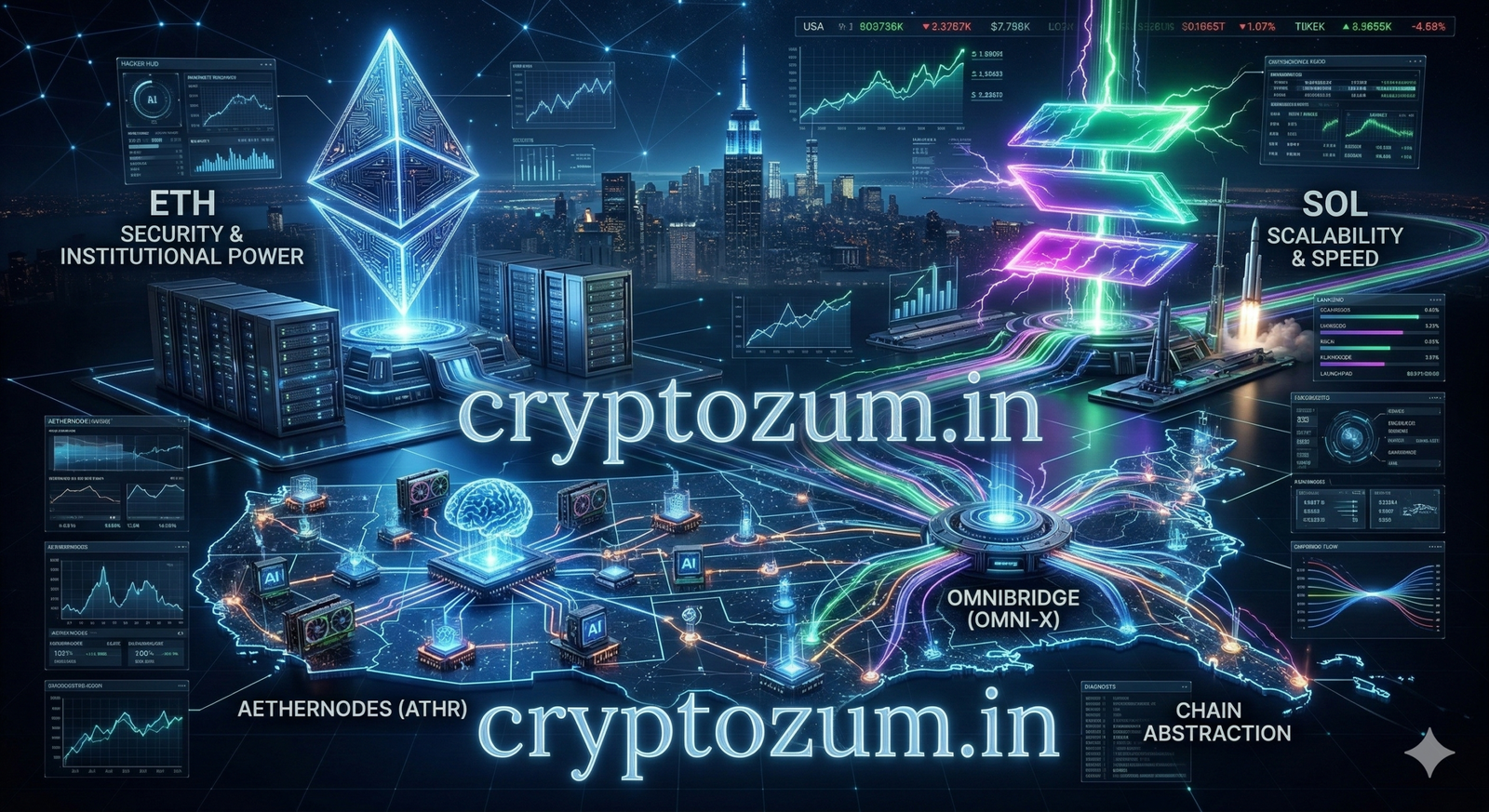
The Definitive Guide to the Two Pillars of the New Digital Economy
The year 2026 has arrived, and the “Crypto Winter” of the early 2020s is a distant memory. We are no longer debating whether Bitcoin is “digital gold” or if NFTs are “just JPEGs.” The conversation has shifted toward Physical Infrastructure and Universal Liquidity. While the “Battle of 2026” between Ethereum and Solana dominates the headlines, the real wealth is being built in the shadows of two massive technical breakthroughs: Decentralized AI Compute and Chain Abstraction. —
💎 Pillar I: AetherNodes (ATHR) – The Decentralized Powerhouse of Artificial Intelligence
The Great Compute Famine
To understand why AetherNodes (ATHR) is the most important asset of 2026, we have to look back at the “Great Compute Famine” of 2025. As AI models like GPT-6 and Claude 4.5 became integrated into every smartphone, car, and corporate office, the demand for raw GPU (Graphics Processing Unit) power outstripped supply by 400%.
Centralized giants like AWS and Microsoft began “Compute Rationing,” prioritizing trillion-dollar corporations and leaving independent developers in the dark. AI innovation was hitting a bottleneck—until AetherNodes solved the hardware problem by treating the world’s idle silicon as a single, unified brain.
The Proof-of-Useful-Work (PoUW) Model
AetherNodes didn’t just create another token; they created a Layer-1 DePIN (Decentralized Physical Infrastructure Network). Unlike traditional mining, which wastes electricity on arbitrary math puzzles, ATHR miners perform “Inference” and “Training” for real-world AI companies.
- Distributed Training: A medical startup in India can train a cancer-detection model using the combined power of 5,000 gaming PCs in the USA and Europe.
- Privacy Sharding: Sensitive data is broken into encrypted fragments (shards). No single node ever sees the full dataset, ensuring corporate-level privacy on a public network.
- The ATHR Token Utility: $ATHR is the “Gas” for AI. If you want to run a query on a decentralized LLM, you pay in ATHR. This creates a constant, non-speculative buy pressure.
2026 Market Analysis: Compute as a Commodity
In 2026, Compute is the New Oil. * AetherNodes Market Cap: $42 Billion (Estimated Q1 2026).
- Network Capacity: 5.2 Exaflops of decentralized power.
- Institutional Adoption: Partnered with 12 “Auto-Pilot” EV manufacturers to handle real-time spatial data processing.
💎 Pillar II: OmniBridge (OMNI-X) – The Protocol That Killed the “Blockchain Border”
The Death of the “Bridge”
For years, the biggest weakness of crypto was “Fragmentation.” If you had money on Ethereum, you couldn’t easily spend it on a Solana dApp. “Bridges” were the solution, but they were dangerous. In 2024 alone, bridge hacks accounted for billions in lost user funds.
OmniBridge (OMNI-X) changed the game by introducing Chain Abstraction. In 2026, users no longer care what “chain” they are on. OmniBridge is the invisible “Internet Protocol” (IP) that allows value to flow like water across the entire ecosystem.
Atomic-State Synchronization (The “Human” Explanation)
OmniBridge doesn’t “move” money. It uses Zero-Knowledge (ZK) State Proofs. When you buy a digital asset on Chain A using funds from Chain B:
- OmniBridge “proves” the funds exist on Chain B.
- It simultaneously “triggers” the purchase on Chain A.
- The transaction is Atomic—it happens everywhere at once or not at all. There is no “in-between” state where a hacker can steal the funds.
The Rise of the “Universal Wallet”
Because of OmniBridge, the @digitgateway.tech team predicts that by the end of 2026, 90% of crypto users will use “Universal Wallets.” You won’t have a “Solana Wallet” or an “Ethereum Wallet.” You will have a Value Address.
- You receive your salary in USDC on Base.
- You pay for coffee using Solana-Pay.
- You stake your savings in an Ethereum-based Yield Vault.
- OmniBridge handles the conversions instantly and invisibly in the background.
Economic Impact: The Trillion-Dollar Liquidity Hub
OmniBridge has solved the “Liquidity Fragmentation” problem. In 2026, a DeFi protocol on a small, new Layer-3 chain can tap into the deep liquidity of Bitcoin and Ethereum instantly. This has led to a 300% increase in DeFi TVL (Total Value Locked) across the board.
📊 2026 Strategic Comparison Table
| Feature | AetherNodes (ATHR) | OmniBridge (OMNI-X) |
| Primary Goal | Decentralize AI Compute Power | Unify Global Blockchain Liquidity |
| Industry Sector | AI / DePIN / Hardware | Infrastructure / Interoperability |
| Hacker Factor | High (Empowers independent AI) | Extreme (Enables cross-chain exploits/defense) |
| 2026 Revenue Model | Commission on GPU Rental Fees | Micro-fees on Cross-Chain Swaps |
| Risk Profile | Moderate (Depends on AI growth) | Low (Infrastructure is always needed) |
| Why Invest? | You are betting on the “Intelligence Age” | You are betting on the “Internet of Value” |
🚀 The Synergy: When AI Meets Interoperability
The most exciting part of 2026 is where these two giants meet. We are seeing the rise of Autonomous AI Traders—bots built on AetherNodes that use OmniBridge to hunt for arbitrage opportunities across 50 different blockchains simultaneously.
These bots never sleep. They use the massive compute power of ATHR to predict market moves and the instant liquidity of OMNI-X to execute trades. This is the “Hacker Economy” in its purest form: Automated, Decentralized, and Unstoppable.
Final Verdict for the DigitGateway Community
If you are looking for the “Next Big Thing” beyond the ETH vs. SOL debate:
- Accumulate ATHR: It is the foundation of the AI-driven world.
- Hold OMNI-X: It is the toll booth for the entire multi-chain future.
The future of the USA’s digital economy isn’t just about which logo is bigger—it’s about who owns the Compute and who owns the Connection. —
A Message from cryptozum
Stay ahead of the curve. The 2026 bull run isn’t just about price; it’s about the tech that changes how humans interact with value.